
From Service to Discovery: Fred’s Story
Across the world, veterans transition out of service having lived with structure, shared purpose and deep camaraderie. When that chapter ends, the shift to civilian life can be unexpectedly jarring, not just in routine, but in connection, identity and the way they engage with the world around them.
All too often, when the uniform comes off, these factors can dissipate with it.
For Fred, who served 12 years in the Air Force, this transition meant learning to approach life differently, not just in what he did, but in how he thought, responded and connected with others.
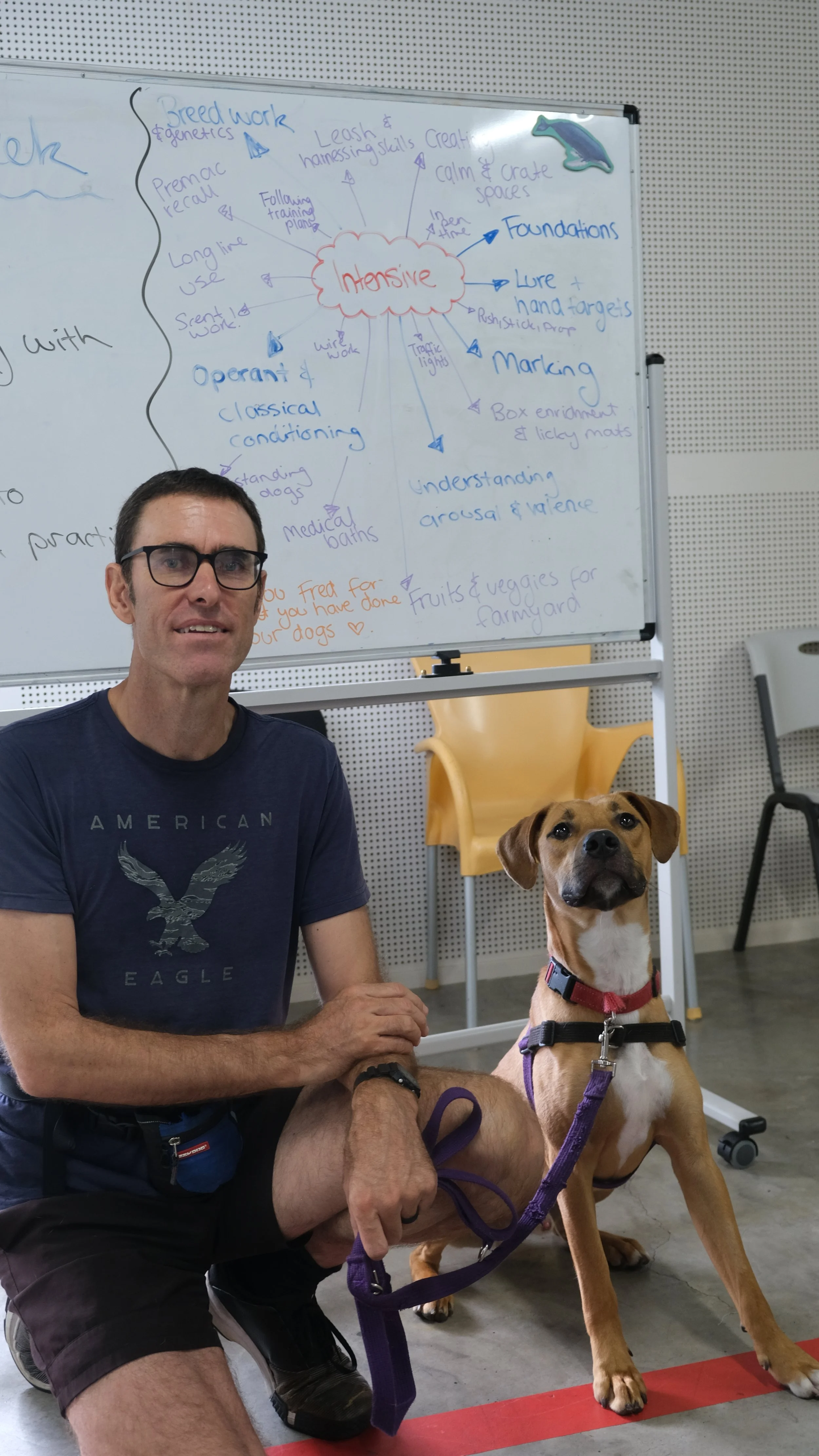
It was during this time that Fred’s Rehabilitation Consultant introduced him to Happy Paws Happy Hearts’ Intensive Train Program, delivered at their partner location with RSPCA Queensland, at the Brisbane Animal Care Campus.
The Intensive Train Program forms part of what are known as ‘return to life’ programs, holistic approaches that support veterans to rebuild purpose, connection and confidence beyond service.
Rather than focusing on a single outcome, these programs create opportunities for learning, contribution and community connection; each valuable on its own, but together, form a powerful foundation for long-term wellbeing and positive change.
For Fred, what he found in the program was a different kind of structure. One that still required discipline and focus, but allowed space for reflection, adaptability and growth.
Each week, Fred worked hands-on with rescue dogs, helping to train, socialise and support them on their journey towards rehoming, by developing practical animal care and training skills, while contributing to something beyond himself.
Rebuilding Purpose Through Contribution
A defining feature of effective return to life programs is the ability to offer meaningful contribution, not just participation.
Through his work with the rescue dogs at RSPCA Queensland, Fred experienced this firsthand.
“One of the most rewarding things was being able to observe what a dog needed and then actively choose how I could help support that need, and ultimately, help them feel better by using the skills I was learning and building on each week,” he shared.
“Just as I had choices, one of the most incredible things to witness was the small choices the dogs made; if, and how, they wanted to engage with me.
Because of my own experience with anxiety, I think I became quite good at recognising this in dogs and helping to build their confidence in a structured and supported way. Seeing these dogs switch from anxious to trusting and calm, and ultimately make good choices meant everything to me, it has been the most rewarding thing”, Fred shared.
One incredible example of positive choice was on Fred’s last day in the program where he chose to work with a deeply anxious senior dog, Diesel.
Like many dogs adjusting to the unfamiliar and often overwhelming environment of a shelter, Diesel was exhibiting elevated stress responses. This presented as loud, persistent barking and a fixation to his toys, both of which are recognised coping strategies in dogs but can be perceived as undesirable behaviours by potential adopters.
Fred chose to work with Diesel as he could see the importance of helping shift his behaviours to a more positive one, helping give this older dog the best chance of finding a home where he no longer needed to rely on coping behaviours. As Fred approached Diesel’s pen, Diesel barked continuously, jumping at the door. With calm intention, Fred began working from outside the pen, marking and rewarding moments of stillness and quiet, until slowly, the barking eased. When Diesel began to settle, Fred entered the pen.
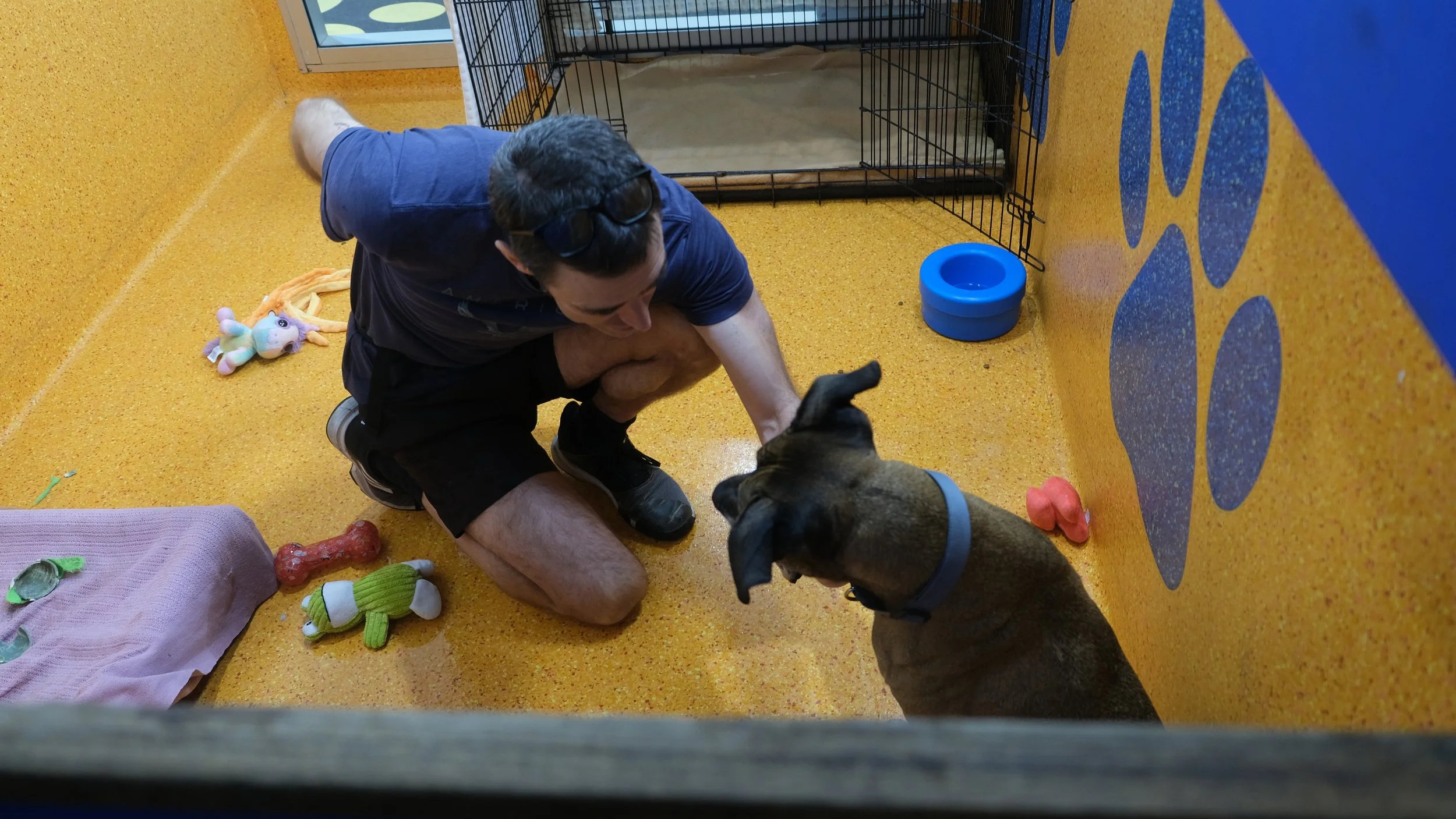
Fred working in-pen to calm Diesel
Inside, Diesel’s anxiety shifted into another behaviour fixating intensely on toys, darting around the pen and urging Fred to engage in play. While this may have been what Diesel wanted in the moment, Fred recognised what he needed: calm, consistent connection without adding to the overstimulation.
For the next 10–15 minutes, Fred remained steady and patient, offering gentle, reassuring touch while Diesel continued to circle. Then, a micro-moment where Diesel paused and looked toward Fred. Fred noticed it instantly, marking and rewarding the moment.
Program Trainer Leah, observing closely, described the change:
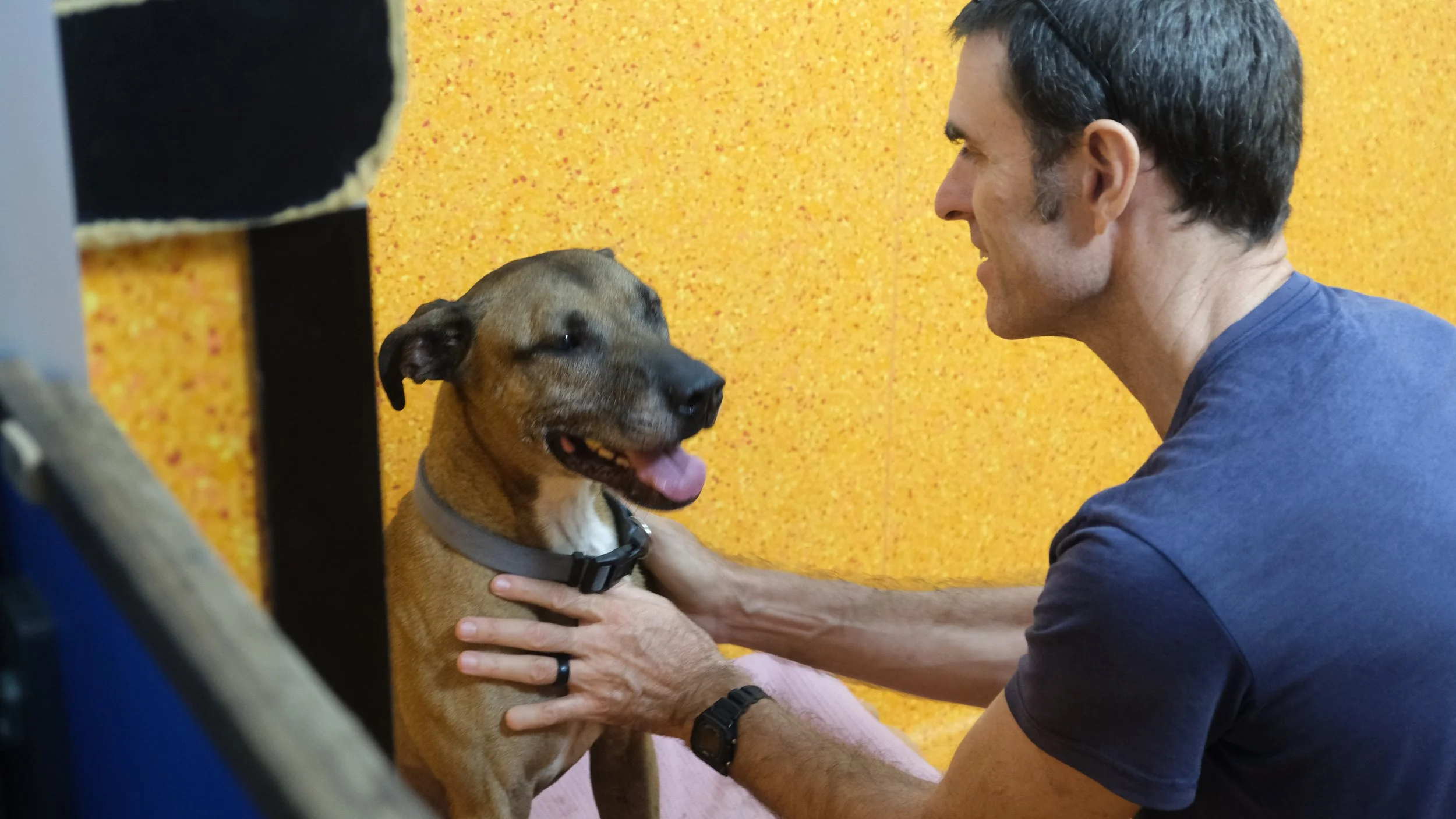
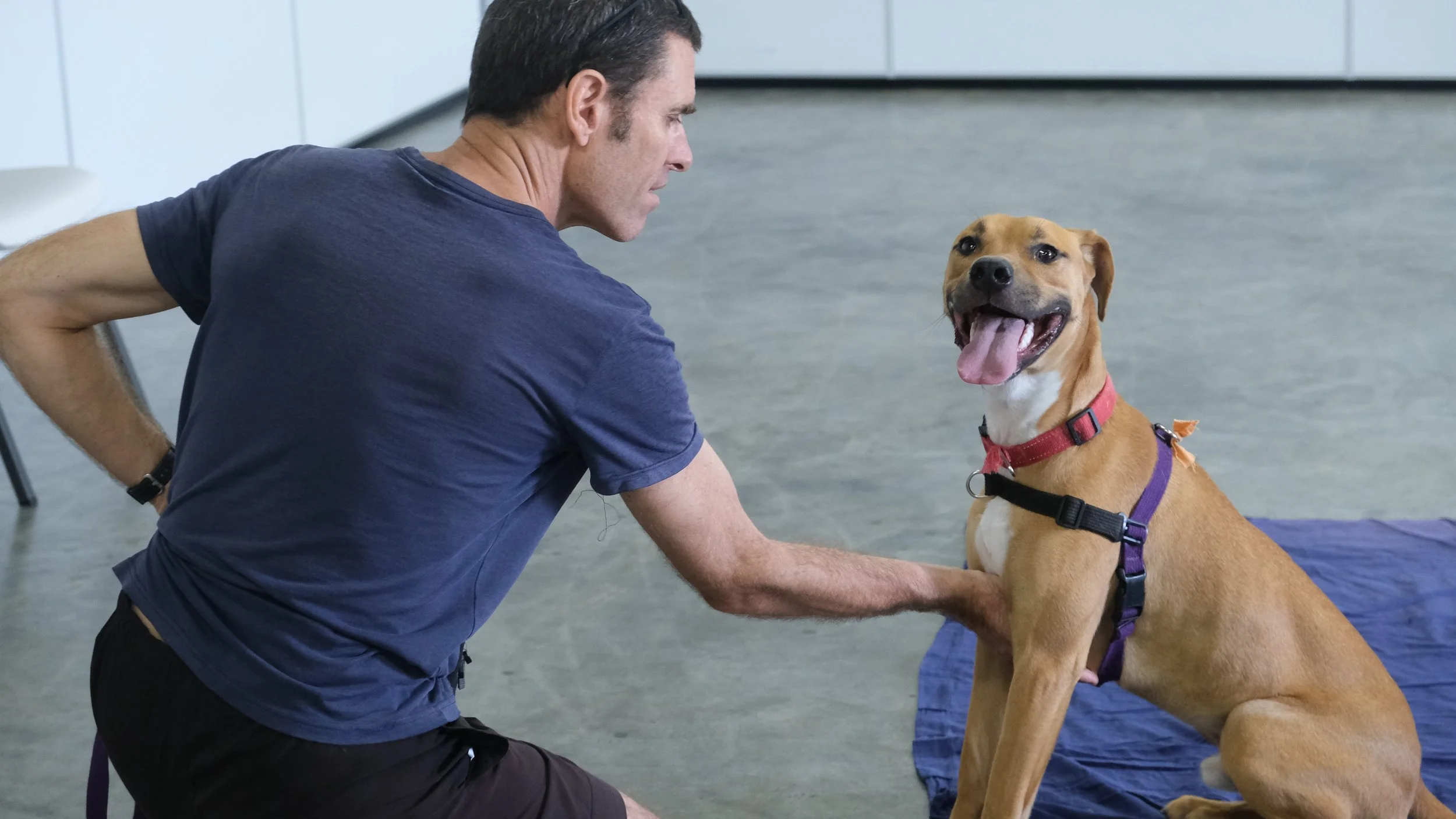
Diesel and Fred (L-R)
“Diesel’s body language began to soften. You could see him realise he had a choice, to stay in that anxious loop, or to engage with the person offering him patience, care and safety.”
Then, in another incredible moment, Diesel let go of the toy. He moved closer to Fred, his body softening and his face settled into a quiet, content expression.
A moment built through patience, presence and the simple act of allowing choice. These moments (which are plentiful throughout the entirety of a program), often small, but deeply significant, reinforce a renewed sense of purpose for participants.
"Working with dogs like Diesel has been incredibly informative, but also intense and at times emotional. That was a really powerful moment for me, I felt proud to have supported him even for just a short time", Fred shared.
The success of helping an animal in care experience these new positive associations require compassion, confidence, competence and above all, patience.
“I remember engaging early on in the program with a particular dog, trying some kind of training and being told by Leah to pause and give the dog it’s time to think…and for me it felt like a lifetime and I didn't quite understand what we were waiting for,” he says.
Over time, Fred noticed his approach shifting from reacting, to observing more deeply.
He began to recognise how behaviour in shelter animals is shaped by a variety of factors.
“One of the first things I noticed was that dogs think differently and at different speeds. Their cognition and resulting behaviours vary depending on their genetics, current circumstances, past experiences and health”. In a short while, Fred realised that this is not just for animals, but relevant for people too.
From Animal Behaviour to Human Insight
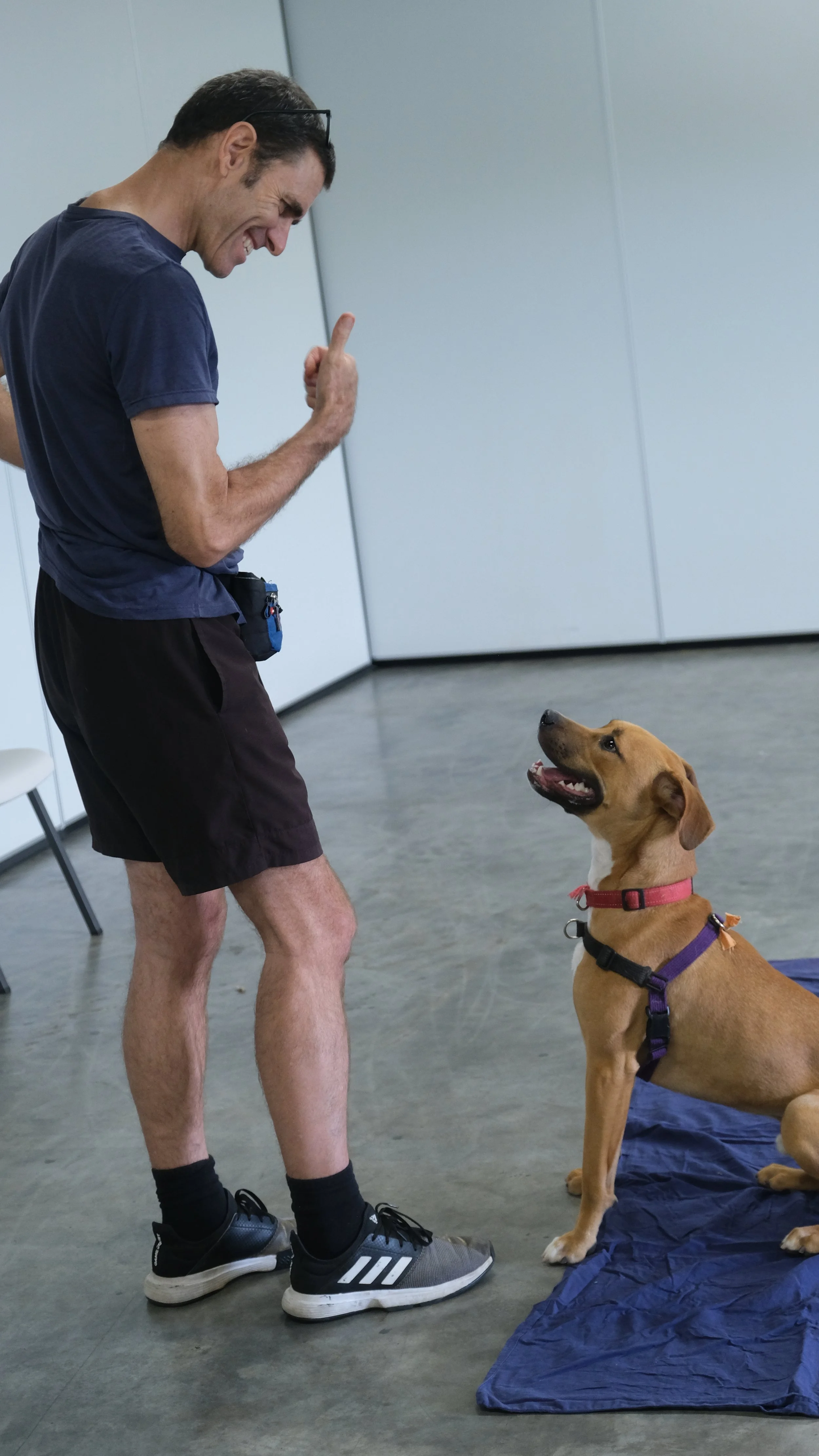
Through learning to read animal body language (particularly dogs), from subtle signals to more overt behaviours, Fred began to draw parallels with human interaction.
“If there were two things I’d take away,” he says, “it would be predictability and choice”.
Working with dogs highlighted the importance of giving animals agency, allowing them to make choices (like in his interaction with Diesel), rather than forcing outcomes. This understanding extended into his personal relationships.
“It’s reminded me that people need that same sense of choice and agency…We don’t always consciously give that to others, but it’s important to do so.
When you’re paying attention to an animal's emotional state, you start to recognise those feelings in yourself as well. It’s helped me understand some of my own emotions."
Over the 12 weeks, Fred developed strong capabilities in animal handling and training, from recognising micro-signals in behaviour to adapting his own responses in real time to deliver training and care which reflected the animals’ needs.
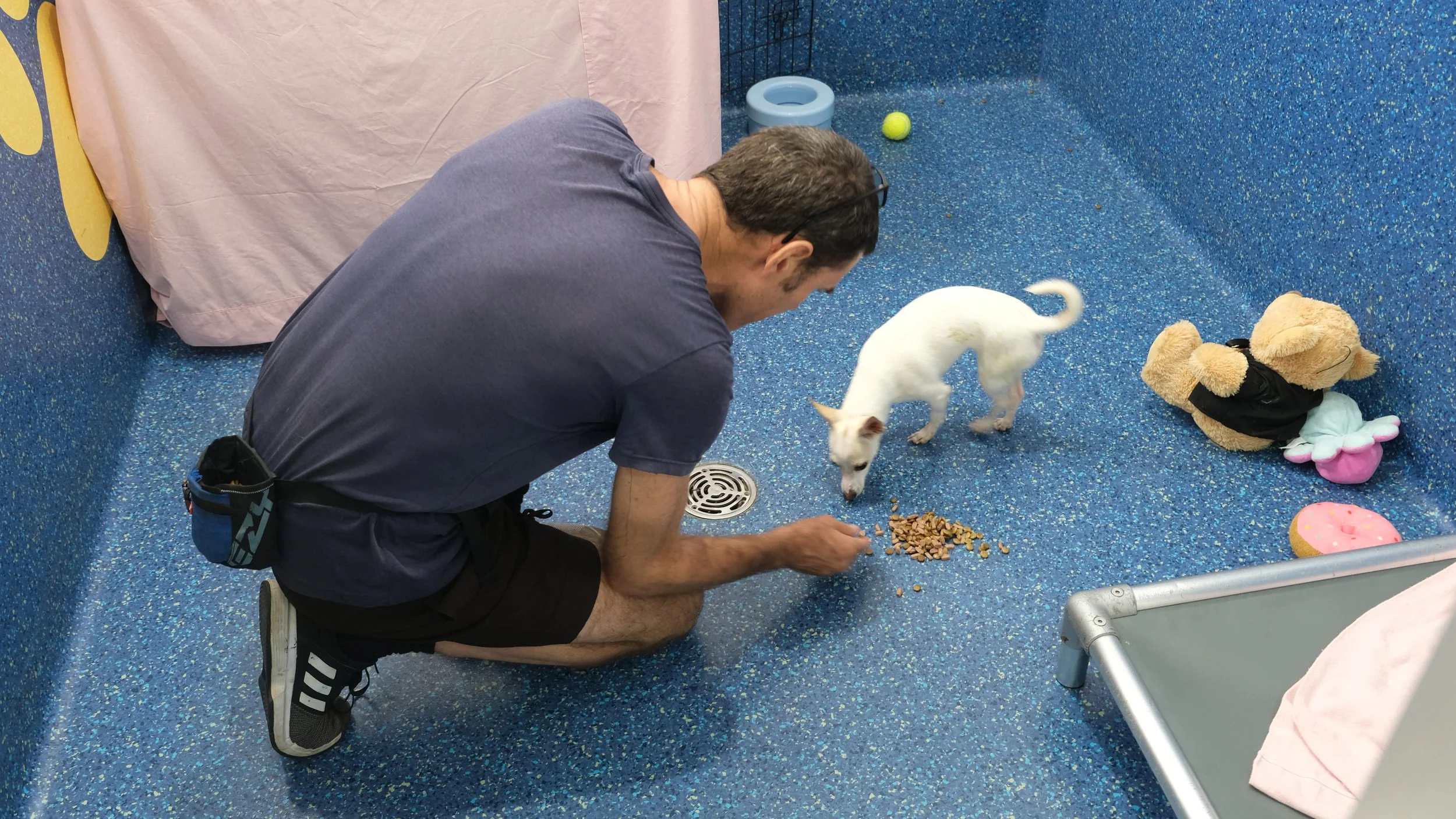
In his final session, Fred spent time in the RSPCA Brisbane Animal Care Campus Adoption Centre, choosing to work with three dogs he felt would benefit from calm, patient interaction to support their journey to adoption. Each interaction held its own meaningful moment—from Diesel choosing to engage calmly, to building training skills with an energetic puppy, to helping a small Chihuahua find the confidence to eat, simply by having a calm and supportive presence nearby.
For Fred, the moments that stood out most were not the biggest, but the smallest.
“I was proud of the little choices the dogs made,” he says. “Those moments where they chose to trust, to engage, to feel safe.”
These outcomes had a dual impact: Supporting the dogs’ wellbeing and adoptability, and reinforcing Fred’s own sense of achievement and personal growth.
Over the course of 12 weeks, Fred worked alongside 23 dogs, each interaction contributing to their care, confidence and readiness for life beyond the shelter, while strengthening his own sense of purpose along the way.
We are incredibly proud of the care, commitment and dedication Fred brought to each session. He embraced his learning with intention, taking the time to deeply understand not only the skills he was developing, but the role he could play in supporting the animals. Through this, he showed a willingness to be open, to reflect, and to grow alongside the animals he worked with.
Why Programs Like This Matter
Programs like Intensive Train offer something different by combining skill development, purposeful contribution, community connection and emotional and behavioural learning to promote positive psychosocial outcomes.
Fred is looking forward to his next chapter, one which he hopes he can continue to give back and make a difference in the lives of animals in need through volunteering or other vocational pathways and fostering dogs in need of a short-term home. For now, he is looking forward to down-time where he can appreciate his learning journey at Happy Paws Happy Hearts and the impact he has contributed to for many animals in care.
Happy Paws Happy Hearts is proud to continue to offer the Intensive Program across various sites in Australia, creating a more holistic pathway for veterans, one that creates real, measurable change, for both people and paws.
For more information, visit our website at https://www.hphhfoundation.org/intensive-shelter-program